IT Security Outsourcing: Why UK Companies Can’t Afford to Ignore Cyber Threats
Most businesses only realise the gap after a breach. A staff member clicks a suspicious link on a Monday morning, and by Tuesday the company is locked out of its own systems, fielding calls from panicked clients and scrambling to contact their insurer. It is a scenario playing out across the UK with alarming regularity and the businesses it hits hardest are rarely the ones that took the risk lightly. They are the ones that simply did not act in time. This is why outsourced IT security management has become a critical strategy for UK companies that want to stay ahead of threats rather than react to them after the damage is done.
The Rising Cyber Threat Landscape Facing UK Businesses
Why are UK SMEs Prime Targets?
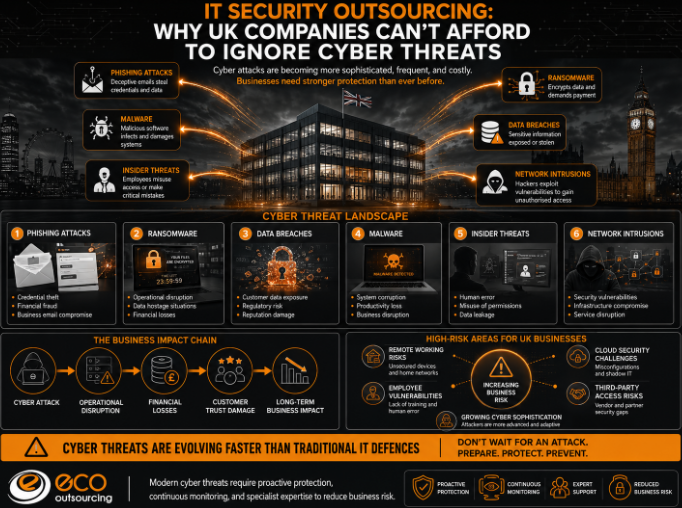
There is a common assumption that cyber criminals go after big fish banks, government bodies, multinationals. The reality is far more indiscriminate. Modern attackers use automated tools that probe thousands of businesses simultaneously, looking for the path of least resistance. A small accountancy firm in Leeds with outdated software is just as vulnerable as a London enterprise, arguably more so, because it likely has fewer defences in place.
Remote work has made the situation worse. Employees logging in from home networks, using personal devices, and accessing cloud tools through unsecured connections have opened up a vastly wider attack surface than existed five years ago. Weak password policies compound the problem. Many breaches start with something embarrassingly simple.
Most Common Cyber Threats in 2026
Phishing remains the entry point for the majority of attacks. Business email compromise where attackers impersonate a supplier or senior executive to redirect payments has cost UK businesses hundreds of millions in recent years. Ransomware continues to shut down operations overnight, with recovery timelines stretching into weeks. Insider threats, whether malicious or accidental, are consistently underestimated. And as more businesses migrate to cloud platforms without proper configuration, misconfigurations have become one of the fastest-growing causes of data exposure.
Real Impact of a Cyber Attack
Beyond the immediate chaos, the financial fallout from a breach is significant. Downtime alone can cost thousands per hour depending on the business. Add to that data recovery costs, regulatory fines under GDPR which can reach up to £17.5 million or 4% of global annual turnover and the reputational hit that follows when clients find out their data was compromised. Some businesses never fully recover commercially from a serious incident.
Understanding IT Security Outsourcing in Simple Terms
What Does It Actually Mean?
At its core, outsourcing your IT security means handing the monitoring, management, and response function to an external team of specialists. Rather than relying on an internal IT person who juggles security alongside a dozen other responsibilities, you get a dedicated team whose sole focus is protecting your systems around the clock.
Think of it less like hiring a contractor and more like gaining access to an entire security department without the overhead of building one yourself.
What Services Are Included?
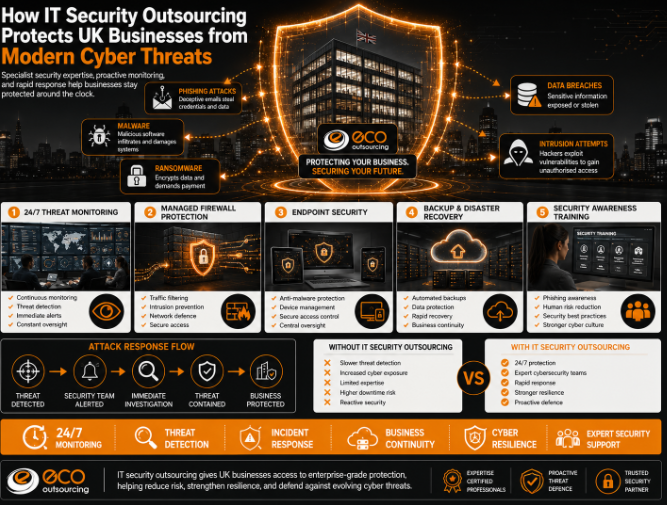
The scope varies by provider, but a solid managed security package typically covers a Security Operations Centre (SOC) that monitors your environment 24/7, Endpoint Detection and Response (EDR) tools that identify threats on individual devices, firewall management, incident response when something goes wrong, and compliance monitoring to keep you aligned with regulations like GDPR and Cyber Essentials.
How It Works in Practice?
The day-to-day cycle is straightforward: continuous monitoring feeds into automated and human-led threat detection, which triggers a response when something suspicious is flagged, followed by detailed reporting so you always know what happened and why. You are not left in the dark. Good providers give you visibility into your security posture without expecting you to become a technical expert overnight.
The Business Case for Outsourcing Cybersecurity
Cost Efficiency vs In-House Teams
Hiring a qualified cybersecurity professional in the UK costs upwards of £60,000 a year and that is before you factor in the tools they need, ongoing training, holiday and sick cover, and the reality that one person cannot monitor threats at 3am. For most UK businesses, outsourced IT security management delivers the equivalent capability for a fraction of that cost, typically on a predictable monthly fee.
24/7 Protection Without Internal Burden
Cyber attacks do not respect business hours. Ransomware commonly deploys overnight or over weekends precisely because that is when defences are weakest. An outsourced security partner means someone is always watching, and response times are measured in minutes rather than the hours it might take for an internal team to even become aware of an incident.
Access to Enterprise-Level Expertise
The tools used by managed security providers, advanced SIEM platforms, threat intelligence feeds, behavioural analytics are simply out of reach for most SMEs when purchased independently. Outsourcing effectively pools that investment across many clients, meaning a twenty-person firm gets access to the same calibre of protection as a much larger organisation.
What Happens If You Ignore Cybersecurity Outsourcing?
Financial Impact
The average cost of a cyber attack on a UK SME runs into tens of thousands of pounds when you account for ransom payments, lost productivity, emergency IT costs, and the time leadership spends managing the fallout rather than running the business. For some, particularly those in professional services or e-commerce, a week of downtime can be catastrophic.
Legal and Compliance Risks
GDPR places a legal obligation on businesses to protect personal data. A breach does not automatically result in a fine, but failure to demonstrate adequate security measures significantly increases that risk. The ICO has shown it will act and fines are not symbolic gestures. Beyond fines, businesses must report certain breaches within 72 hours, a process that is considerably more stressful without a security partner already in place to help manage it.
Reputation Damage
Client trust, once broken, is genuinely difficult to rebuild. A breach that exposes customer data does not just create a legal problem.it creates a commercial one. Contracts get reviewed. Tenders get lost. Word spreads. The businesses that suffer most are those that had to publicly admit they were unprepared.
Common Cybersecurity Myths That Put Businesses at Risk
“We Are Too Small to Be Targeted”
Attackers are not making manual decisions about which businesses to target. Automated scanning tools hit every IP address indiscriminately. If your systems have a weakness, it will be found regardless of your company size or sector.
“Cloud Providers Handle Everything”
This is one of the most dangerous misconceptions in business technology today. Cloud providers like Microsoft and AWS operate on a shared responsibility model they secure the infrastructure, but the security of what you put in it is your responsibility. Misconfigured storage buckets and weak access controls are your problem, not theirs.
“Antivirus Is Enough”
Traditional antivirus works by recognising known threats. Modern attacks are specifically designed to evade signature-based detection. Fileless malware, zero-day exploits, and social engineering tactics bypass antivirus entirely. It is a starting point, not a strategy.
“Outsourcing Means Losing Control”
Understandable concern but the opposite tends to be true. Reputable providers give clients real-time dashboards, monthly reports, and clear documentation of everything happening in their environment. You actually end up with more visibility than most businesses have with purely internal management.
In-House IT Security vs Outsourced Protection
| Factor | In-House | Outsourced |
| Cost | High (salaries, tools, training) | Predictable monthly fee |
| Expertise | Limited by team size | Specialist, multi-disciplinary |
| Availability | Office hours only | 24/7/365 |
| Response Time | Hours (if covered) | Minutes |
| Scalability | Slow and expensive | Immediate |
| Tooling | Basic to mid-range | Enterprise-grade |
For most UK SMEs, the in-house model simply does not stack up. The economics do not work, the coverage is inadequate, and the skills gap in the UK cybersecurity market makes hiring genuinely difficult. Mid-sized businesses sometimes opt for a hybrid model: a small internal IT team supported by an outsourced SOC which can work well when the internal team handles day-to-day operations and the external partner handles monitoring and response.
Step-by-Step Cybersecurity Outsourcing Process
Step 1 Risk Assessment: Before anything is deployed, a good provider maps your current risk exposure to what data you hold, how it is accessed, where your vulnerabilities sit, and what your regulatory obligations are.
Step 2 Security Audit: A full audit of your existing infrastructure, policies, and access controls establishes a baseline and identifies the gaps that need addressing most urgently.
Step 3 Deployment of Tools: EDR agents are deployed across endpoints, firewalls are configured or replaced, and your environment is connected to the SOC’s monitoring platform.
Step 4 Continuous Monitoring: From this point, your systems are monitored around the clock. Alerts are triaged by analysts who distinguish genuine threats from false positives.
Step 5 Incident Response and Reporting: When a threat is confirmed, the response team acts immediately containing the incident, preserving evidence, and communicating clearly with your team throughout.
Step 6 Ongoing Optimisation: Security is not a one-time project. Regular reviews, updated threat intelligence, and evolving configurations ensure your protection keeps pace with the threat landscape.
Is Outsourced Cybersecurity Safe?
A common question businesses ask before committing is whether outsourced IT security management is actually trustworthy and it is a fair one.
Data Protection Measures
Reputable providers encrypt data in transit and at rest, enforce strict access controls with multi-factor authentication, and maintain detailed audit logs of every action taken within your environment. You are not handing over control to a black box.
Compliance Standards
When choosing a provider, look for alignment with GDPR requirements, ISO 27001 certification (the international standard for information security management), and Cyber Essentials or Cyber Essentials Plus accreditation both of which are UK government-backed schemes that provide meaningful assurance.
Transparency and Reporting
Monthly security reports should tell you what threats were detected, how they were handled, and what your current risk posture looks like. Real-time dashboards give you an always-on view without requiring you to interpret raw data yourself.
Choosing the Right IT Security Outsourcing Partner
Key Selection Criteria
Look for a provider with demonstrable experience working with UK SMEs in your sector. Verify their certifications. Ask specifically about SOC availability. Is it truly 24/7 or does it scale back overnight? Understand their incident response SLAs: how quickly will they act, and what does escalation look like?
Red Flags to Avoid
Walk away from any provider that cannot clearly explain their monitoring process, refuses to commit to SLA guarantees in writing, or cannot produce compliance documentation on request. Vague assurances are not acceptable when your business continuity is at stake.
Cybersecurity Risks by Industry
Legal Firms: Client confidentiality is both a professional obligation and a regulatory requirement. A breach exposing case files or communications can trigger SRA investigations alongside ICO action.
Accounting and Finance: Financial data is among the most valuable to cyber criminals. Fraud, identity theft, and business email compromise targeting payment processes are persistent risks.
Healthcare: Patient records carry an enormous sensitivity premium. Breaches in this sector attract intense regulatory scrutiny and can cause direct harm to individuals.
E-commerce: Payment system attacks, credential stuffing, and supply chain compromises targeting checkout platforms make e-commerce businesses a constant target.
The Future of IT Security Outsourcing in the UK
AI-driven threat detection is already changing what is possible in managed security. Machine learning models can identify anomalous behaviour patterns far faster than human analysts working alone, reducing the window between intrusion and detection from hours to seconds. Zero Trust architecture, the principle that no user or device should be trusted by default, even inside a network is moving from enterprise best practice to SME expectation. Hybrid SOC models, blending automated detection with human-led response, are becoming the standard delivery model. And as UK regulatory pressure continues to increase, particularly around supply chain security and data residency, the compliance function of outsourced security will become even more central to the decision.
Frequently Asked Questions
Why are UK businesses increasingly outsourcing their IT security?
The rise in sophisticated cyber attacks, combined with a severe shortage of in-house cybersecurity talent, has pushed UK businesses toward external specialists. Outsourcing gives them access to round-the-clock monitoring and enterprise-grade tools without the cost and complexity of building that capability internally. For most SMEs, it is simply the more practical and affordable path.
What is the difference between a managed security provider and a regular IT support company?
A standard IT support company keeps your systems running, fixing hardware, managing software, and resolving user issues. A managed security provider focuses exclusively on protecting those systems from threats. The two roles are complementary but distinct. Many businesses make the mistake of assuming their IT support covers security in any meaningful depth, and that assumption tends to get tested at the worst possible moment.
How quickly can a cyber attack bring down a UK business?
Faster than most people expect. Ransomware can encrypt an entire network within minutes of execution. Business email compromise can result in significant financial loss before anyone realises something is wrong. Without active monitoring in place, the average time to detect a breach in the UK is measured in days by which point the damage is already done.
Is IT security outsourcing only suitable for large businesses?
Not at all,in fact, SMEs arguably benefit more. Large enterprises have the budget to build internal security teams. Smaller businesses do not, which makes outsourcing the only realistic way to achieve comparable protection. A well-structured managed security service scales to the size and needs of the business, meaning a ten-person firm can access the same quality of protection as a company ten times its size.
What should a UK business do first if it suspects a cyber attack is underway?
Do not switch off systems or attempt to investigate independently that can destroy forensic evidence needed later. The immediate priority is to contact your security provider or incident response team, isolate affected devices from the network where possible, and avoid using compromised email accounts to communicate. Having an outsourced security partner already in place means this process starts in minutes rather than hours, which makes a significant difference to the outcome.
Conclusion
The cost of prevention is a fraction of the cost of recovery. Businesses that treat cybersecurity as a reactive measure consistently pay more, suffer longer, and face greater reputational damage than those that acted before a breach occurred. The threat landscape is not going to simplify and the expectations from clients, insurers, and regulators are only going to rise.
Eco Outsourcing helps UK businesses stay ahead of that curve. From 24/7 monitoring and incident response to compliance support and endpoint protection, we handle the security complexity so you can focus on what you do best. Every client gets a setup built around their specific environment: no generic packages, no vague promises.Eco Outsourcing is here to make sure it is always the former.