The Fall of the Knights Templar: How Friday the 13th Became a Day of Dread
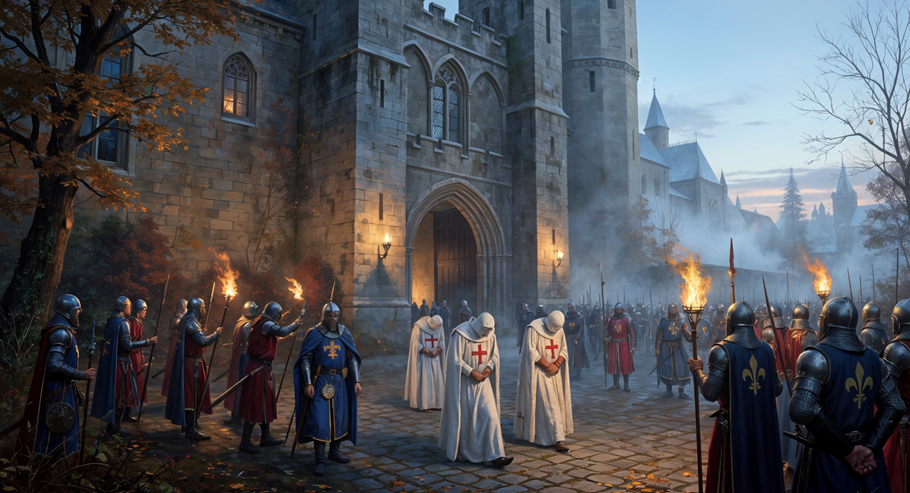
Before dawn on Friday, October 13, 1307, sealed orders from King Philip IV of France were opened simultaneously by royal agents across the kingdom. Within hours, nearly every member of the Knights Templar on French soil — somewhere between 600 and 2,000 men — was dragged from sleep and placed under arrest. It was the most coordinated mass detention in medieval European history, and it unfolded with a precision that still surprises historians studying this pivotal chapter in medieval history. The charges were staggering: heresy, idol worship, financial corruption, and obscene initiation rituals. The Order that had once served as Christendom’s most formidable military force was, in a single morning, brought to its knees.
A King Drowning in Debt
To understand why Philip IV moved against the Templars, you need to follow the money. France was effectively bankrupt. Philip had already debased the coinage multiple times — so aggressively that Parisians rioted in 1306. He had expelled and seized the assets of Jewish moneylenders and Lombard bankers. He had even taxed the French clergy so heavily that it triggered a bitter conflict with Pope Boniface VIII, culminating in the infamous incident at Anagni in 1303, where Philip’s agents physically assaulted the pope.
The Order, by this point, had evolved far beyond its origins as warrior monks guarding pilgrims on the road to Jerusalem. They had become the medieval equivalent of an international bank. Their network of preceptories across Europe held enormous wealth — land, treasure, and a sophisticated system of credit that even kings relied upon. Philip IV himself had taken refuge in the Paris Temple during a riot. He knew exactly how much the Templars were worth. And he owed them a great deal of money.
The king’s chief minister, Guillaume de Nogaret, was the architect of the arrests. A lawyer from Languedoc, ruthless and methodical, Nogaret was the same man who had orchestrated the attack on Boniface VIII. He drafted the arrest warrants, coordinated with local bailiffs, and ensured that the operation was carried out before the Templars could move their assets or flee.
The Charges and the Confessions
The accusations leveled against the Templars read like a catalogue of every medieval fear about secret societies. Initiates were said to deny Christ three times, spit or urinate on the crucifix, engage in homosexual acts, and worship a mysterious idol called Baphomet — a bearded head that supposedly gave the Order its power. The charges were almost certainly fabricated, drawing on standard inquisitorial templates that had been used against heretics and other groups Philip wanted destroyed.
Under torture, many Templars confessed. The methods used by Philip’s inquisitors included the strappado — suspending a prisoner by the wrists tied behind the back — foot roasting, sleep deprivation, and starvation. At least 36 Templars died during interrogation in Paris alone. Grand Master Jacques de Molay, a man in his seventies who had served the Order for decades, confessed within days. So did most of the senior leadership.
But confessions extracted under torture are unreliable, and even medieval observers knew it. When Templars were later questioned by papal commissioners — under somewhat less coercive conditions — many retracted their confessions. In 1310, 54 Templars who had recanted were burned at the stake outside Paris as relapsed heretics, a move designed to terrorize anyone else who might dare to speak the truth.
Clement V: The Pope Who Couldn’t Say No
Pope Clement V occupied one of the most unenviable positions in papal history. A Frenchman elected to the papacy in 1305, he never set foot in Rome, instead establishing the papal court at Avignon — effectively under the shadow of the French crown. Clement owed his election to Philip’s influence, and he spent his pontificate trying to balance the king’s demands against the Church’s institutional authority.
When Philip arrested the Templars, Clement was furious — not because he particularly loved the Order, but because the king had acted without papal authorization, and the Templars were technically answerable only to the pope. Clement tried to assert control by launching his own investigation. In 1308, he personally interviewed a group of senior Templars at Chinon Castle, and the results were recorded in what is now known as the Chinon Parchment.
This document, rediscovered in the Vatican Secret Archives in 2001 by historian Barbara Frale, is one of the most significant finds in Templar scholarship. It shows that Clement absolved the Templar leadership of heresy after hearing their confessions, granting them the sacraments of the Church. The pope, it appears, did not believe the charges. But he lacked the political power to stand up to Philip.
At the Council of Vienne in 1312, Clement formally dissolved the Order — not by condemning them, but by papal provision, a procedural maneuver that avoided an outright guilty verdict. The Order’s assets were theoretically transferred to the Knights Hospitaller, though in practice Philip managed to siphon off a substantial portion. The Templars ceased to exist as an institution after nearly two centuries of service.
The Last Stand of Jacques de Molay
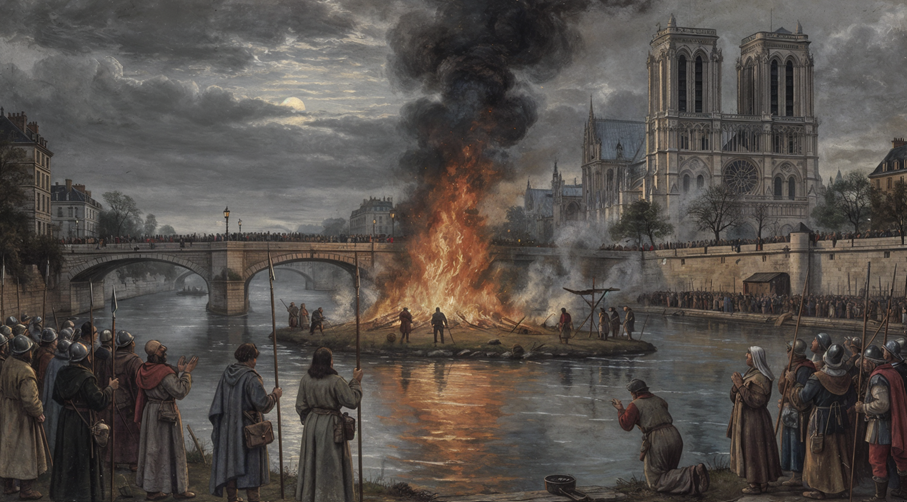
Jacques de Molay spent seven years in prison. During that time, he wavered — confessing, retracting, confessing again — under relentless pressure. In March 1314, he and three other senior Templars were brought before a public assembly at Notre-Dame de Paris to hear their sentences: life imprisonment.
But something changed in de Molay at that moment. Instead of accepting the sentence, he stood before the crowd and recanted his confession entirely. He declared the Order innocent and his previous admissions the product of torture. Geoffroi de Charney, Preceptor of Normandy, joined him in the retraction.
Philip IV, enraged, ordered both men burned that same evening on a small island in the Seine — the Île des Javiaux, near the present-day Pont Neuf. According to the chronicle of Geoffroi de Paris, de Molay faced the flames with extraordinary composure. Legend holds that as he burned, he summoned both Philip and Clement to join him before God’s tribunal within a year. Clement died on April 20, 1314. Philip followed on November 29 of the same year. Whether coincidence or curse, it cemented the Templar story in the medieval imagination.
Friday the 13th: History or Hollywood?
Here is where the story gets complicated. The popular claim that Friday the 13th became unlucky because of the Templar arrests is repeated so often that most people accept it without question. It makes for a compelling origin story — a day of mass betrayal giving birth to a lasting superstition. But the historical evidence is thin.
The fear of Friday the 13th — known as paraskevidekatriaphobia — does not appear in written records until the 19th century. Folklore scholar Nathaniel Lachenmeyer traces the modern superstition to a confluence of two separate traditions: the long-standing unease around the number 13 (linked to the Last Supper, where Judas was supposedly the 13th guest) and the medieval association of Friday with bad luck (Christ’s crucifixion occurred on a Friday). The specific combination of the two as a single unlucky day appears to have gained traction only in the late 1800s.
The direct link to the Templar arrests was popularized largely by Dan Brown’s 2003 novel “The Da Vinci Code” and the wave of Templar-themed books and documentaries that followed. There is no medieval source that connects the date of the arrests to a broader superstition about Friday the 13th. The arrests certainly happened on that date — the historical record is clear about that — but whether anyone at the time considered it particularly ominous is another matter entirely.
That said, the Templar connection has become so embedded in popular culture that it functions as a kind of retroactive mythology. Even if the Templar arrests didn’t create the Friday the 13th superstition, their dramatic fall has become inseparable from it in the public mind. The story is simply too good — too cinematic, too conspiratorial — to let go of.
An Order That Refused to Disappear
More than seven centuries after their dissolution, the Knights Templar remain one of history’s most debated subjects. The Chinon Parchment suggests the pope himself didn’t believe they were guilty. The trial records reveal confessions obtained through systematic torture. Philip IV got his money, but the Templars got something perhaps more enduring — an almost mythic status that has outlasted the French monarchy itself.
Dozens of organizations today claim Templar lineage, from Masonic rites to neo-chivalric orders. The red cross on the white mantle has become one of the most recognizable symbols of the entire medieval period.
What happened to the rank-and-file members after 1312 is less glamorous. Many were absorbed into other religious orders, particularly the Hospitallers. In Portugal, King Denis I simply renamed the local branch the Order of Christ and carried on as before — a pragmatic solution that tells you everything about how seriously some monarchs took the heresy charges.
The fall of the Templars was not really about heresy or idol worship or secret rituals. It was about power, money, and a king who had run out of people to rob. October 13, 1307, was the day a medieval superpower learned that no amount of wealth or papal privilege could protect it from a determined sovereign with an empty treasury and a compliant pope. Whether or not it made Friday the 13th unlucky, it certainly made it unforgettable.